
Strong financial advisory firms are built on trust, long-term relationships, and consistent results. When it comes time to sell, those qualities play a big role in the business’s value. If you want to understand your firm’s worth, a business valuation for selling a financial advisory firm is essential. This analysis provides owners with the data they need to negotiate with confidence and navigate complex decisions effectively.
Peak Business Valuation values financial advisory firms across the United States. We can answer your questions and offer critical insight into the value of a financial advisory. If you are seeking a business valuation for selling a financial advisory firm, begin today by scheduling a free consultation.
The Purpose of a Business Valuation for a Financial Advisory Firm
Valuing a financial advisory firm refers to determining its fair market value. This value represents how much a buyer might pay for the firm based on current market conditions. The valuation process looks at factors such as financial records, industry trends, and client data. Business appraisers also consider both tangible and intangible assets, like reputation and clientele. This comprehensive analysis helps the valuation expert reach an accurate valuation.
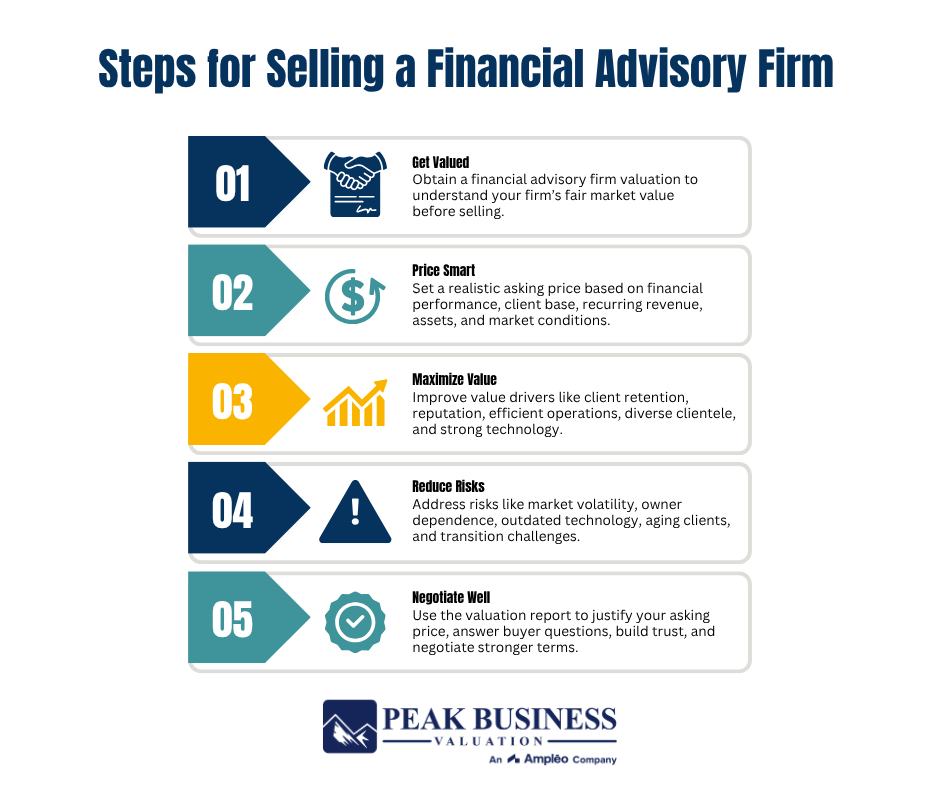
For someone selling a financial advisory firm, a business valuation is a vital tool. It conveys how the business compares to others in the market. A business appraisal also helps sellers set a realistic asking price. This foreknowledge strengthens the seller’s position during negotiations.
In this article, we discuss the importance of a business valuation for selling a financial advisory firm. If you have any questions, schedule a free consultation with Peak Business Valuation!
Understanding the Fair Market Value of a Financial Advisory Firm
Business appraisers use various valuation approaches when determining how to value a financial advisory firm. The right approach depends on the business’s strengths, structure, and market conditions. Professional business valuations often use a combination of approaches for the most accurate result. Below, we discuss each of the valuation approaches:
- Market Approach: This approach compares the firm to similar businesses that have recently sold. It reflects current market trends and competitive pricing. The market approach is especially useful when industry sales data is available. Financial advisory valuation multiples are key to this method.
- Income Approach: The income approach looks at the firm’s ability to generate future income. It reviews past earnings, projects future cash flow, and adjusts for risk. It works well for firms with recurring revenue from client relationships.
- Asset Approach: This approach values the business based on its assets. Tangible assets may include office equipment and technology. Intangible assets like client lists, brand reputation, and goodwill also play a role. To determine the financial advisory firm’s net value, liabilities are also subtracted.
Using these approaches together creates a clearer picture of a firm’s market worth. This helps sellers set realistic expectations and attract serious buyers. Check out How to Value a Financial Advisory to learn more.
Maximizing the Value of a Financial Advisory Firm
Next, sellers can make efforts to increase their firm’s value before opening it to the market. Value drivers are factors that impact how much a business is worth. Focusing on these elements can make a financial advisory firm stand out in a competitive market. As such, identifying and improving these drivers before selling can help owners set a higher price. They may also be able to negotiate better terms. Common value drivers for a financial advisory firm include:
- Client Retention: High client retention rates signal strong trust and satisfaction. Buyers value firms that can keep clients through leadership changes or ownership transitions.
- Strong Reputation: A positive reputation helps attract and keep clients. This can help the firm appeal to more buyers and lead to a higher sale price.
- Efficient Operations: Streamlined processes, effective technology, and clear workflows improve profitability. These processes also reduce the time and cost required to manage the business. This efficiency makes the firm easier for a new owner to run.
- Diverse Clientele: Serving a variety of industries and demographics minimizes risk. If one segment experiences a downturn, others can offset the loss. This reliability may lead to a higher valuation.
A business valuation for selling a financial advisory firm highlights these potential strengths. By cultivating them, sellers can position their firm for the best possible outcome. See Value Drivers for a Financial Advisory Firm for more details.
Identifying Risks When Selling a Financial Advisory Firm
Risks also play a part in a financial advisory firm’s value. These are factors that can lower the value or make a business less appealing to buyers. When valuing a financial advisory firm, it is important to understand these risks and address them early. This preparation can prevent hesitant buyers and increase the selling price. Below, we discuss common risks for a financial advisory firm:
- Market Volatility: When client investments suffer, it can reflect poorly on a financial advisory. As such, a volatile market may lead to a lower appraisal.
- Reliance on Key Individuals: Relying heavily on the owner or a key individual can create challenges. It often makes ownership transitions more difficult. Establishing an efficient management team and skilled employees can mitigate these risks.
- Outdated Technology: Inefficient technology slows down operations and can frustrate clients. This issue may lower the firm’s market value.
- Aging Clients: If most clients are near retirement, future revenue may decline. Buyers want a mix of client ages to ensure long-term income. Without diversifying clientele, sellers may receive a low valuation.
Mitigating these risks can increase buyer confidence and improve the final sale price. Addressing them early can make a major difference when valuing a financial advisory firm for sale.
Peak Business Valuation is a licensed business appraiser. We are here to provide you with a financial advisory business valuation to determine your firm’s market position. You can rely on this data to improve your standing before entering the market.
Determining a Realistic Listing Price for a Financial Advisory Firm
When selling a business, owners must set a listing price. This price will guide negotiations with potential buyers. Setting it too high can push buyers away, while a low price can lead to financial loss. Obtaining a business valuation for selling a financial advisory firm can help sellers find the right balance. A business appraisal provides a clear, data-backed understanding of the firm’s worth. It considers financial performance, client base, and market conditions.
Moreover, using a business valuation helps promote transparency between buyer and seller. Buyers can see that the asking price is based on data, not guesswork. It builds trust and makes negotiations smoother. A realistic listing price can also speed up the sale process and attract more serious offers.
Utilizing a Valuation Report When Selling a Financial Advisory Firm
After assessing the firm’s performance, valuation experts create a business valuation report. This report outlines the findings of a business valuation for a financial advisory firm. It includes the financial advisory firm’s fair market value, strengths, weaknesses, opportunities, and risks. Sellers can use this report to justify their asking price and answer buyer questions. The valuation report also serves as a reliable reference throughout the selling process. Check out Business Valuation Report Made Simple for more insight.
Conclusion
Selling a financial advisory firm is a big step. Understanding its value helps you make confident plans for the future. Moreover, a financial advisory valuation provides clarity, strengthens your position in negotiations, and builds trust with potential buyers. With this knowledge, you can move forward and work toward the best possible outcome.
Peak Business Valuation often works with businesses preparing for sale. We provide insights to help make the transaction smooth and successful. Schedule a free consultation with Peak today to learn more about valuing a financial advisory.