If you need to understand the fair market value of a restaurant franchise, valuation multiples can provide a quick and practical estimate. These tools help compare your franchise to similar businesses that have recently sold. When applied appropriately, restaurant franchise valuation multiples can be helpful for tentative planning and low-stakes business decisions. As such, learning how to value a business using multiples is beneficial whether you are buying, expanding, or selling a restaurant franchise.
This article discusses the most common multiples for restaurant franchises. Additionally, we discuss the limitations of relying on these metrics for key financial decisions. Please note that the benchmarks presented here are derived from general market data and may result in misleading valuations. If you need an accurate analysis of your restaurant franchise’s worth, consider working with a professional business appraiser.
Peak Business Valuation is a professional business appraisal firm that regularly helps restaurant franchise owners. If you are looking to buy, grow, sell, or secure financing for a restaurant franchise, we can support you with a professional business valuation. In addition, we are here to answer any questions you may have about how to value a restaurant franchise. You can get started by scheduling a free consultation below!
What Are Restaurant Franchise Valuation Multiples?
Restaurant franchise valuation multiples are financial ratios used to estimate the fair market value of a franchise. To determine an appropriate multiple, valuation analysts examine recent sales of comparable restaurant franchises. The chosen multiple is then applied to key financial metrics, such as earnings or revenue, to calculate the company’s market value. To learn more about applying these multiples, see Valuation Multiples for a Restaurant Franchise.
Common Restaurant Franchise Valuation Multiples
During a restaurant franchise valuation, Peak Business Valuation commonly uses multiples based on SDE, EBITDA, and revenue. Each of these metrics focuses on a different aspect of the franchise’s financial performance. To provide a more precise valuation, business appraisers often assess a variety of multiples together. Below, we outline the most common valuation multiples for a restaurant franchise.
SDE Multiples for a Restaurant Franchise
Seller’s Discretionary Earnings (SDE) indicate the total financial benefit a single owner-operator of a restaurant franchise can expect from the business. To calculate SDE, business appraisers adjust net income by adding back items like the owner’s salary, benefits, and discretionary expenses. Applying an appropriate multiple to this figure provides an estimate of fair market value. SDE multiples are most often used for smaller, owner-operated restaurant franchises.
Formula: Value = SDE × Multiple
Range: Restaurant franchise SDE multiples often fall between 2.74x and 3.36x SDE.
EBITDA Multiples for a Restaurant Franchise
EBITDA (Earnings Before Interest, Taxes, Depreciation, and Amortization) highlights a franchise’s operational profitability by excluding non-operational costs. When working with more complex businesses, this metric offers a clearer picture of financial performance. Moreover, it allows for straightforward comparisons across similar businesses. As such, EBITDA multiples are generally applied to larger restaurant franchises with more complex operations.
Formula: Value = EBITDA × Multiple
Range: Restaurant franchise EBITDA multiples typically range from 3.82x to 4.17x EBITDA.
Revenue Multiples for a Restaurant Franchise
Revenue multiples compare a franchise’s value to its total sales over a 12-month period. While this metric does not reflect a business’s profitability, it can provide useful insight when reviewed alongside SDE or EBITDA multiples.
Formula: Value = Revenue × Multiple
Range: Restaurant franchises generally transact between 0.29x and 0.66x revenue.
Peak Business Valuation integrates restaurant franchise valuation multiples during a comprehensive business valuation. In addition, we consider factors like operational efficiency, risks, and market dynamics that affect the company’s overall value. This ensures the final estimate reflects the franchise’s true performance, market position, and growth potential. If you want to learn more about how to value a restaurant franchise, schedule a free consultation with Peak Business Valuation below!
How to Value a Restaurant Franchise Using Multiples
On paper, using valuation multiples may seem straightforward. However, achieving accurate results requires a deeper analysis of various factors. When valuing a restaurant franchise, business appraisers consider factors such as risk, growth potential, and local market demand before selecting and applying multiples. Weighted averages may also be used to account for fluctuations in earnings or sales. These adjustments ensure the valuation reflects the franchise’s actual performance. For more insight into the valuation process, see How to Value a Restaurant Franchise.
Rules of Thumb for Restaurant Franchises
Valuation multiples are considered rule-of-thumb methods for valuing a restaurant franchise. These tools can provide helpful guidelines when estimating fair market value. However, because multiples are derived from comparable sales, they may not fully capture your franchise’s unique strengths or challenges. Consequently, relying on valuation multiples for important business decisions is risky. If you need a valuation for buying, expanding, selling, or securing financing for a restaurant, it is vital to work with a certified valuation expert. Reach out to Peak Business Valuation today if you have any questions.
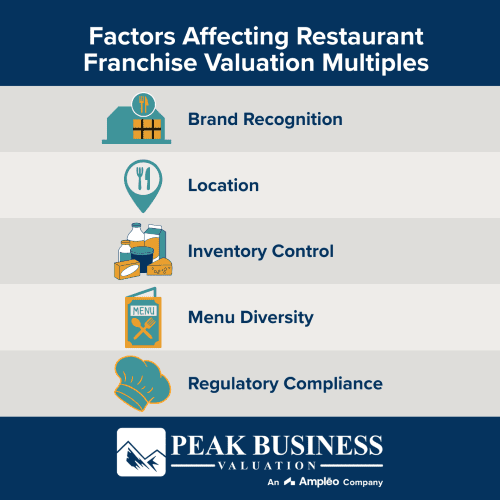
Factors Affecting Restaurant Franchise Valuation Multiples
Several factors can impact whether a restaurant franchise receives high or low valuation multiples. Understanding these elements allows owners to strengthen their franchise’s performance and market appeal. Some key considerations include:
- Brand Recognition: Restaurants that operate under well-established brand names often capture a larger market share and foster strong customer loyalty. This creates steady and predictable revenue streams, making the business more valuable to potential buyers.
- Location: Being positioned in a high-traffic location near key markets can significantly influence a restaurant’s profitability and growth potential. These are critical factors that enhance the business’s perceived value.
- Inventory Control: Franchises that efficiently manage inventory, orders, and food waste can maximize profit margins while minimizing inefficiencies. This indicates stability and supports higher restaurant franchise valuation multiples.
- Menu Diversity: Offering a diverse menu helps attract a wider customer base and enhance revenue stability. This can have a notable impact on the market value of a restaurant franchise.
- Regulatory Compliance: Ensuring compliance with health, safety, and labor regulations minimizes the risk of fines, operational disruptions, or reputational damage. With a strong track record of compliance, franchise owners can instill confidence in buyers, leading to stronger valuation multiples.
To learn more about what impacts a franchise’s worth, see Value Drivers for a Restaurant Franchise.
Conclusion
Valuation multiples provide an initial estimate of a franchise’s market value based on similar companies that were recently sold. They can be a useful reference when trying to gauge a franchise’s value during early-stage planning. However, valuation multiples are based on general market data and often overlook unique elements that impact your business. As such, relying solely on multiples for restaurant franchises to make key business decisions can lead to costly mistakes. If you need an accurate and credible business valuation, it is best to connect with a certified and experienced business appraiser.
As a trusted business appraiser, Peak Business Valuation frequently helps restaurant franchise owners with professional business valuations. If you are preparing to sell, expand, or secure financing, we can provide essential insights and answer any questions about how to value a restaurant franchise. Get started by scheduling your free consultation with Peak Business Valuation today!
For more information, read Valuing a Restaurant Franchise or Restaurant Franchise Valuations.