An SBA business valuation estimates what a business is worth, while a Quality of Earnings report determines whether the earnings supporting the transaction are accurate, supported, and recurring. The SBA business valuation vs Quality of Earnings comparison starts with a simple distinction: the reports may review some of the same financial information, but they answer different questions. Under SOP 50 10 8.1, certain acquisitions with a Business Purchase Price of $3.0 million or more require both an independent business valuation and a separate Quality of Earnings report.
Peak Business Valuation provides both SBA business valuations and SBA Quality of Earnings analyses for lenders nationwide. While the two services can be coordinated to reduce duplicate document requests, they remain separate engagements with different purposes and required analyses.
SBA Business Valuation vs Quality of Earnings: What Is the Difference?
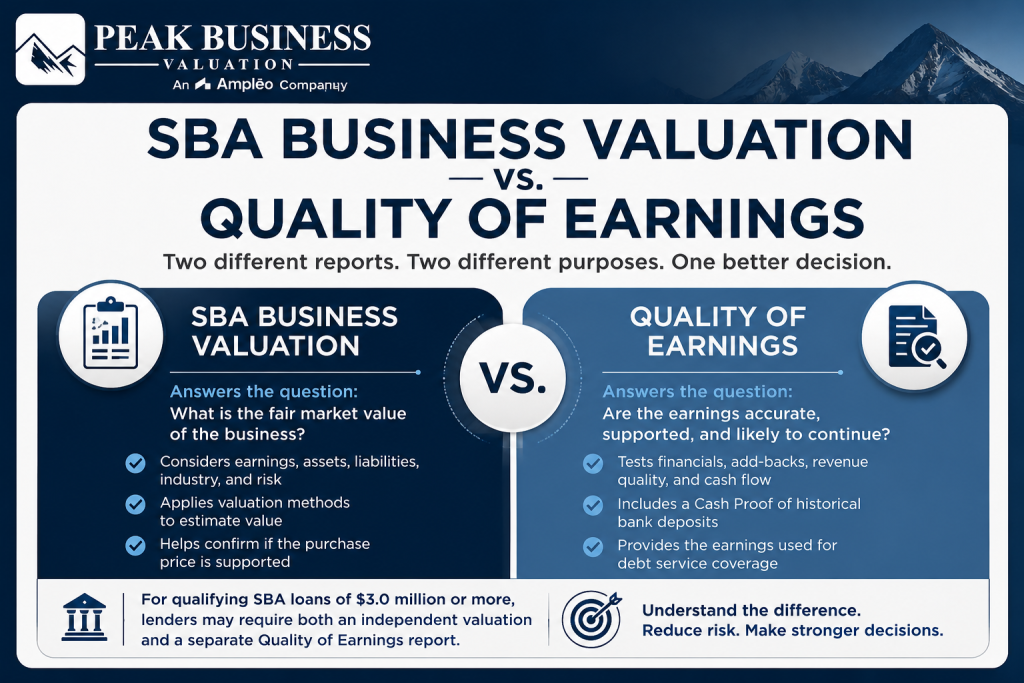
The primary difference is the question each report answers. An SBA business valuation estimates the fair market value of the business. A Quality of Earnings report tests whether the earnings supporting the transaction are accurate, supported, and likely to continue after closing.
What does an SBA business valuation determine?
An SBA business valuation answers one primary question:
What is the fair market value of the business or ownership interest being acquired?
The appraiser considers factors such as historical earnings, assets, liabilities, industry conditions, competition, customer concentration, management, and other company-specific risks. The appraiser then applies the appropriate valuation methods to estimate the value of the business.
Normalized earnings are often part of that analysis. For example, owner compensation, personal expenses, nonrecurring costs, and related-party transactions may be adjusted when sufficient support exists.
The resulting valuation helps the lender determine whether the purchase price is supported. Peak’s SBA business valuation requirements article explains when an independent valuation is required.
What does a Quality of Earnings report determine?
A Quality of Earnings report answers a different question:
Are the company’s reported earnings accurate, supported, and likely to continue after closing?
The QoE analyzes the financial information supporting the transaction, including accountant-prepared financial statements, internal financials, tax returns, IRS transcripts, and bank activity. It also tests proposed add-backs and reviews revenue quality, customer concentration, margin changes, accounting differences, and related-party transactions.
The required SBA scope also includes a Cash Proof covering the trailing twelve-month period and the prior two fiscal years.
In short, the QoE focuses more directly on whether the earnings used to support the transaction can be verified.
Where do the two reports overlap?
Both reports may review:
- Tax returns
- Income statements
- Balance sheets
- General ledgers
- Owner compensation
- Proposed add-backs
- Historical earnings
Both may also consider whether historical results are representative of the company’s ongoing operations.
However, the overlap does not make the reports interchangeable. In the SBA business valuation vs Quality of Earnings comparison, the valuation uses normalized earnings as one input when estimating value. The QoE focuses on testing the reliability and sustainability of those earnings.
For example, assume a company reports $1.0 million of EBITDA. The valuation asks what an informed buyer would pay for the company based on its earnings, assets, growth, and risk. The QoE asks whether the $1.0 million is actually supported after testing the revenue, margins, add-backs, customer relationships, and cash collections.
Why can the valuation and QoE show different earnings?
The two reports can reach different earnings figures because they have different scopes and may rely on different levels of supporting documentation.
A valuation may receive a schedule of proposed adjustments, while the QoE tests the records supporting those adjustments. Depending on the circumstances, that may include the general ledger, invoices, payroll records, contracts, and bank statements.
A QoE may also identify issues such as:
- Unsupported add-backs
- Revenue cut-off errors
- Accounting-basis differences
- Unrecorded liabilities
- Deferred expenses
- Unusual collection patterns
- Customer losses
A difference between the reports does not automatically mean either professional made an error. The lender should compare the period analyzed, accounting basis, definitions, source documents, and purpose of each adjustment.
Which earnings are used for debt service coverage?
For qualifying transactions under SOP 50 10 8.1, the lender must use the QoE earnings in its debt service coverage calculation.
For example, assume the business valuation used normalized EBITDA of $850,000. The completed QoE later supports only $760,000 after rejecting an unsupported add-back and identifying a revenue issue.
The lender’s repayment analysis must use the supported QoE earnings. If the supported earnings do not support the proposed debt, the transaction may need to be restructured through a lower loan amount, additional buyer equity, more seller financing, or a lower purchase price.
Does a Quality of Earnings report determine business value?
No. A Quality of Earnings report does not apply valuation methods or conclude the fair market value of a business. A QoE can affect the earnings used in a valuation or underwriting model, but it does not replace the SBA business valuation.
The same is true in reverse. An SBA business valuation does not automatically satisfy the required SBA QoE scope. Including normalized earnings or financial analysis in a valuation does not make it a separate Quality of Earnings report.
Can the same firm prepare both reports?
A lender should consider independence, professional qualifications, engagement scope, and any applicable conflict requirements when one firm performs both services.
When the same firm prepares both reports, the engagements should remain separate and clearly identify their different purposes. The valuation and QoE should also have separate analyses and workpapers.
There can still be efficiencies. A coordinated document request can reduce duplicate requests to the borrower while allowing the business valuation and Quality of Earnings analysis to remain separate engagements.
When might a lender request both below $3 million?
The mandatory QoE requirement is a minimum requirement for covered transactions. Below the $3 million threshold, a lender may still order an SBA Quality of Earnings report when the transaction presents additional risk.
Examples may include:
- Weak or inconsistent financial records
- Significant proposed add-backs
- High customer concentration
- Significant changes in revenue or margins
- Related-party transactions
- Bank deposits that do not align with reported sales
For example, a $2.5 million acquisition with weak accounting records and $600,000 of proposed adjustments may require more financial due diligence than a larger acquisition with clean financial records and limited adjustments.
Professional judgment remains important even when a QoE is not mandatory.
The Quality of Earnings checklist and Peak’s explanation of when a QoE is needed can help lenders identify these situations early.
The Bottom Line
The SBA business valuation vs Quality of Earnings distinction comes down to purpose. A business valuation estimates what the business is worth, while a Quality of Earnings report tests whether the earnings supporting the transaction are accurate and recurring.
For qualifying transactions, lenders may need both reports. Identifying that requirement early can help avoid delays and give the lender time to address any issues with the transaction’s cash flow or financing structure.
Peak Business Valuation provides SBA business valuations, SBA Quality of Earnings analyses, and machinery and equipment appraisals for lenders nationwide. By coordinating these services while maintaining separate scopes and analyses, Peak helps lenders move through underwriting with a clearer understanding of both the value of the business and the earnings supporting the transaction.