
Are you looking to understand the value of a recreation business? Valuation multiples can provide a quick estimate of fair market value by comparing your company to similar recreation businesses that have recently sold. When applied correctly, recreation business valuation multiples can be helpful for early-stage planning or minor financial decisions. As such, it is beneficial to learn how to use valuation multiples, whether you are buying, expanding, or selling a recreation business.
This article explains the most common valuation multiples used when valuing a recreation business. We also discuss the limitations of relying solely on these methods for major financial decisions. Please note that the benchmarks we highlight here are based on general market data and will not provide an exact valuation. For the most reliable calculation of your recreation business’s worth, it is best to consult a certified business appraiser.
As a trusted business appraiser, Peak Business Valuation has extensive experience in recreation business valuations. We frequently provide business appraisals for individuals looking to buy, sell, or secure financing for a recreation business. We are happy to address any questions you may have about the valuation process. Schedule a free consultation below to get started!
What Are Recreation Business Valuation Multiples?
Valuation multiples are financial ratios used to estimate the fair market value of a recreation business. To determine an appropriate multiple, valuation analysts examine recent sales of comparable companies in the industry. The multiple is then applied to key financial metrics, such as earnings or revenue, to estimate the company’s fair market value. To learn more about applying recreation business valuation multiples, see Valuation Multiples for a Recreation Business.
Common Recreation Business Valuation Multiples
During a recreation business valuation, valuation experts at Peak Business Valuation commonly use multiples based on SDE, EBITDA, and revenue. Each metric provides an estimate based on a different aspect of the company’s financial performance. To ensure a more precise valuation, business appraisers typically analyze a variety of multiples together. Below, we outline the most common recreation business valuation multiples.
SDE Multiples for a Recreation Business
Seller’s Discretionary Earnings (SDE) represent the total financial benefit available to a single owner-operator of a recreation business. To calculate SDE, the appraiser adjusts net income by adding back items like the owner’s salary, benefits, and discretionary expenses. The selected multiple is then applied to this figure to estimate the company’s worth. SDE multiples are most often used for smaller, owner-operated recreation businesses.
Formula: Value = SDE × Multiple
Range: Recreation businesses often transact within an SDE multiple range of 2.75x to 3.38x SDE.
EBITDA Multiples for a Recreation Business
EBITDA (Earnings Before Interest, Taxes, Depreciation, and Amortization) highlights a company’s operational profitability by excluding non-operational costs. This provides a clearer view of financial performance and allows for more consistent comparisons between companies. EBITDA multiples are generally applied to larger recreation businesses with more complex structures.
Formula: Value = EBITDA × Multiple
Range: Recreation business EBITDA multiples generally fall between 3.52x and 4.32x EBITDA.
Revenue Multiples for a Recreation Business
Revenue multiples compare a company’s total value to its annual sales. Although this metric does not account for profitability, it can still offer useful insights when reviewed alongside SDE or EBITDA multiples.
Formula: Value = Revenue × Multiple
Range: Recreation businesses typically sell between 0.76x and 1.10x revenue.
At Peak Business Valuation, we use recreation business valuation multiples as part of a thorough valuation process. We also consider financial trends, operational efficiency, risks, and market conditions that influence your company’s overall worth. This ensures the valuation reflects your business’s true performance, market position, and future potential. If you want to learn more about how to value a recreation business, schedule a free consultation with Peak Business Valuation below!
How to Value a Recreation Business Using Multiples
Although applying valuation multiples may seem easy, getting accurate results requires expert analysis. Business appraisers consider factors such as risk, growth potential, and local market demand before selecting and applying multiples. They may also use weighted averages to account for fluctuations in earnings or sales. These adjustments ensure the valuation reflects the business’s actual performance. For a more detailed explanation, see How to Value a Recreation Business.
Rules of Thumb for Recreation Businesses
Valuation multiples can serve as helpful rules of thumb when estimating a recreation business’s market value. However, because multiples are derived from comparable companies, they may not fully represent the unique strengths or challenges of your business. As such, they should only be used for informal guidance. For serious business decisions, receiving a professional recreation business valuation is essential. Reach out to Peak Business Valuation today if you have any questions.
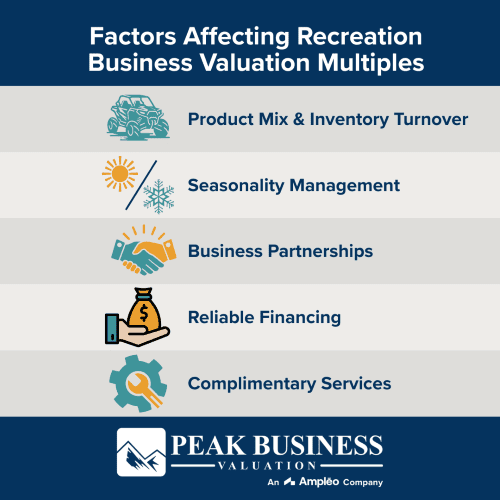
Factors Affecting Recreation Business Valuation Multiples
There are several factors that can influence whether a recreation business receives higher or lower valuation multiples. Understanding these factors allows owners to improve their company’s performance and market appeal. Below are several important elements that affect recreation business valuation multiples.
- Product Mix and Inventory Turnover: Recreation businesses should aim to offer a mix of high demand products, such as boats, ATVs, and accessories. This often leads to stronger financial performance and higher valuation multiples.
- Seasonality Management: Recreation businesses often experience seasonal sales patterns. Effectively managing cash flow and maintaining steady operations year-round helps achieve higher stability and valuation multiples.
- Business Partnerships: Establishing partnerships with camping and RV clubs or trade associations can increase exposure to loyal customers, enhance brand credibility, and promote networking. This can have a major influence on the value of a recreation business.
- Reliable Financing: Providing access to dependable credit and customer financing options increases sales. Strong financing relationships also indicate stability, which promotes higher valuation multiples.
- Complimentary Services: Recreation businesses that provide complimentary repair, maintenance, or storage services often attract repeat customers and create recurring revenue streams. This reduces risk and improves the business’s perceived value.
See Value Drivers for a Recreation Business to learn more.
Conclusion
Recreation business valuation multiples provide a broad estimate of your company’s value based on current market conditions. These tools can guide preliminary decision-making and provide insight into your market position. However, they are based on general market data and often overlook key nuances that impact your company’s value. Relying purely on multiples for important financial decisions can be risky. If you need to determine the exact value of your recreation business, it is best to work with a certified business appraiser.
Peak Business Valuation frequently assists recreation business owners with professional business appraisals. Whether you are preparing to sell, expand, or secure financing, we can provide you with crucial insights and address any questions you may have about how to value a recreation business. Schedule a free consultation below to begin the process!
Read Valuing a Recreation Business or Recreation Business Valuations for more information.