
If you want to understand the value of a software company you are buying or selling, valuation multiples can provide useful insight. These metrics provide a potential fair market value estimate based on current market conditions. When applied properly, software company valuation multiples can support initial planning and informed decision-making.
In this article, we outline the most common market multiples for a software company. We also discuss the implications of relying on multiples for serious financial decisions. Please keep in mind that the benchmarks provided in this article are based on broad market data and may not reflect your company’s true worth. If you need a highly credible software company valuation, it is best to work with a certified business appraiser.
As a trusted business appraisal firm, Peak Business Valuation frequently works with software company owners. Whether you are buying, selling, or looking to finance a software company, we are happy to provide a professional software company valuation. In addition, we are here to answer any questions about valuing a software company. Get started by scheduling your free consultation below!
What Are Software Company Valuation Multiples?
Valuation multiples are financial ratios used to estimate a software company’s fair market value. To identify the most applicable multiples, valuation experts analyze similar companies that were recently sold. Then, the multiple is applied to your business’s financial metrics such as earnings or revenue to estimate fair market value. To learn more about how to value a software company, see Valuation Multiples for a Software Publishing Business.
Common Software Company Valuation Multiples
During a software company valuation, experts at Peak Business Valuation typically apply a combination of various multiples to ensure a balanced estimate. Each valuation multiple assesses a software company’s worth from a different angle. Some of the most common valuation multiples for a software company include SDE, EBITDA, and revenue multiples. We highlight each of these metrics in the following sections.
SDE Multiples for a Software Company
Seller’s Discretionary Earnings (SDE) represents the total economic benefit available to a single owner of the software company. To determine SDE, a business appraiser adjusts net income to account for the owner’s salary, bonuses, and discretionary expenses. A valuation multiple can then be applied to this figure to estimate the business’s fair market value. SDE multiples are most common for small software companies where the owner is actively involved in operations.
Formula: Value = SDE × Multiple
Range: Software company SDE multiples often range between 3.38x and 4.00x SDE.
EBITDA Multiples for a Software Company
EBITDA (Earnings Before Interest, Taxes, Depreciation, and Amortization) reflects how much profit a software company generates strictly from its operations. Since EBITDA removes financing and non-cash expenses, it enables clear comparisons between similar businesses. As such, this approach is frequently used to assess larger software companies with more complex cost structures.
Formula: Value = EBITDA × Multiple
Range: EBITDA multiples for software companies generally fall between 4.21x and 4.97x EBITDA.
Revenue Multiples for a Software Company
Revenue multiples estimate fair market value based on the company’s total sales over a 12-month period. Since these multiples do not account for profitability, they are often less reliable. However, revenue multiples can be helpful when analyzed alongside cash flow multiples such as SDE or EBITDA.
Formula: Value = Revenue × Multiple
Range: On average, software companies transact between 1.03x and 2.59x revenue.
At Peak Business Valuation, our valuation analysts use valuation multiples as part of a full software company valuation. In addition, they take a close look at unique factors that impact your software company’s value. This ensures a more reliable estimate of your software company’s worth. If you have questions about the software business valuation process, schedule a free consultation below!
How to Value a Software Company Using Multiples
While applying valuation multiples may seem straightforward, getting accurate results requires careful analysis and detailed financial adjustments. When identifying appropriate multiples, a business appraiser accounts for the software company’s risk profile and growth opportunities. Weighted averages are also applied when reviewing historical performance and financial projections. This results in a tailored valuation that holds up under professional scrutiny. To learn more, see How to Value a Software Publishing Business.
Rules of Thumb for Software Companies
Valuation multiples are popular rules of thumb for estimating the value of a software business. However, it is important to note that multiples are derived from broad market data and cannot capture the nuances of every business. As such, relying on software business valuation multiples may lead to inaccurate conclusions. If you need a credible software business valuation, consider working with a certified valuation expert. Reach out to Peak Business Valuation today if you have any questions about valuing a software company.
Factors Affecting Software Company Valuation Multiples
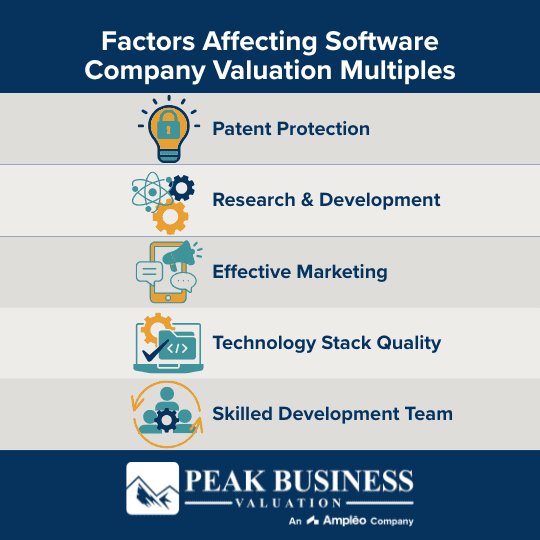
There are a variety of factors that determine whether a software company achieves higher or lower valuation multiples. Identifying these elements can help software company owners determine key strengths and weaknesses. Below are several common value drivers for a software company:
- Patent Protection: When possible, securing patents prevents competitors from copying or using a software company’s technology for a certain period of time. This can limit competition, enable premium pricing, and reduce overall risk, which often results in higher valuation multiples.
- Research & Development (R&D): Investing in continuous R&D helps software publishers release innovative products and adapt to market trends. This reduces obsolescence risk and supports long-term growth, leading to a higher software business valuation.
- Effective Marketing: Implementing effective marketing strategies is essential for positioning new software products to meet customer needs. Software companies that successfully generate market demand can increase revenue potential, which boosts buyer confidence and enhances the company’s perceived value.
- Technology Stack Quality: Having access to efficient technology improves product reliability and scalability. Software companies with maintainable systems often receive stronger valuations due to lower operational risk and minimal reinvestment needs.
- Skilled Development Team: Employing a team of skilled software developers has a direct impact on product quality, development speed, and innovation capacity. Businesses with a strong workforce are often more stable and scalable, supporting stronger valuation multiples.
Focusing on key value drivers can help you position your software company for success. For more guidance on increasing the value of a software company, see Value Drivers for a Software Publishing Business.
Conclusion
Valuation multiples provide a helpful fair market value estimate for early-stage planning. However, valuation multiples do not account for the unique characteristics of every business. As such, relying solely on software business valuation multiples to guide important decisions is risky. If you need a credible business valuation to navigate complex scenarios, it is best to work with a certified business appraiser. These professionals follow a thorough process to provide a reliable estimate of fair market value.
As a professional business appraiser, Peak Business Valuation supports software company owners across the nation. Whether you are buying, selling, or growing your business, we are happy to deliver a timely and credible software business valuation. We are also available to discuss any questions about valuing a software company. Begin today by scheduling your free consultation below!
See Valuing a Software Company or Valuation Multiples for a Software Publishing Business for more information.