
Are you preparing to buy or sell a warehousing company? Understanding the company’s economic worth is essential when navigating a transaction. If you are just looking for a broad estimate, valuation multiples can provide quick market-based results. Business owners and prospective buyers can refer to warehousing company valuation multiples to make informed decisions during early-stage planning.
In this article, we highlight the most common multiples for a warehousing company. We also discuss the implications of relying on multiples for important financial decisions. Please note that the figures we provide in this article are based on general market data and may not reflect your company’s true worth. If you need a credible warehousing company valuation, it is best to work with a professional business appraiser.
Peak Business Valuation is a trusted business appraisal firm with experience in warehousing company valuations. Whether you are buying, selling, or seeking financing for a warehousing company, we can support you with a warehousing company valuation. Peak can also answer any questions you may have about valuing a warehousing company. Get started today by scheduling your free consultation below!
What Are Warehousing Company Valuation Multiples?
Valuation multiples are financial ratios that indicate a warehousing company’s fair market value. Valuation experts compare your warehousing company to similar businesses that have recently been sold to determine applicable multiples. These figures are then applied to key financial indicators, such as the subject company’s earnings or revenue. When used correctly, warehousing company valuation multiples provide helpful insight into your company’s potential market position. Read Valuation Multiples for a Transportation and Warehousing Company to learn more.
Common Warehousing Company Valuation Multiples
When valuing a warehousing company, analysts at Peak Business Valuation often use a combination of various multiples to provide balanced results. Each valuation multiple assesses a warehousing company’s worth from a different perspective. SDE, EBITDA, and revenue multiples are some of the most common valuation multiples for a warehousing company. We review each of these metrics below.
SDE Multiples for a Warehousing Company
Seller’s Discretionary Earnings (SDE) represents the total financial benefit a single owner of the warehousing company can expect. To calculate SDE, net income is adjusted to account for items like the owner’s salary, bonuses, and discretionary expenses. Business appraisers can then estimate the company’s fair market value by applying a multiple to the SDE figure. SDE multiples are most common for small or single-location warehousing companies where the owner is actively involved.
Formula: Value = SDE × Multiple
Range: Warehousing company SDE multiples often transact between 2.82x and 3.26x SDE.
EBITDA Multiples for a Warehousing Company
EBITDA (Earnings Before Interest, Taxes, Depreciation, and Amortization) measures a warehousing company’s core operating profitability. By removing financing and non-cash expenses, EBITDA enables clearer comparisons between businesses. As such, EBITDA is frequently used to assess larger or multi-location companies with complex finances.
Formula: Value = EBITDA × Multiple
Range: EBITDA multiples for warehousing companies generally fall between 3.59x and 3.92x EBITDA.
Revenue Multiples for a Warehousing Company
Revenue multiples measure the value of a business according to its total sales over a 12-month period. Although this metric does not reflect profitability, it can be helpful when reviewed alongside SDE or EBITDA multiples.
Formula: Value = Revenue × Multiple
Range: Warehousing companies usually trade between 0.65x and 0.78x revenue.
As a professional business appraiser, Peak Business Valuation uses valuation multiples during a comprehensive warehousing company valuation. In addition, we consider the impact of your company’s unique strengths and weaknesses. This ensures a reliable, fair market value estimate that stands up under scrutiny. If you have questions about the warehousing company valuation process, schedule a free consultation below!
How to Value a Warehousing Company Using Multiples
Valuing a warehousing company with valuation multiples is simple. However, getting credible results requires professional expertise. When determining appropriate multiples, a business appraiser accounts for key risk factors and growth opportunities. Additionally, they apply weighted averages when reviewing historical trends and financial projections. This ensures the final conclusion of value is supported by sound analysis.
Rules of Thumb for Warehousing Companies
Valuation multiples are general rules of thumb for estimating a warehousing company’s worth. These tools cannot fully capture the nuances of every company and often yield skewed results. As such, relying on warehousing company valuation multiples for business decisions is risky. For the most reliable warehousing company valuation, consider working with an experienced business appraiser. Contact Peak Business Valuation today if you have any questions!
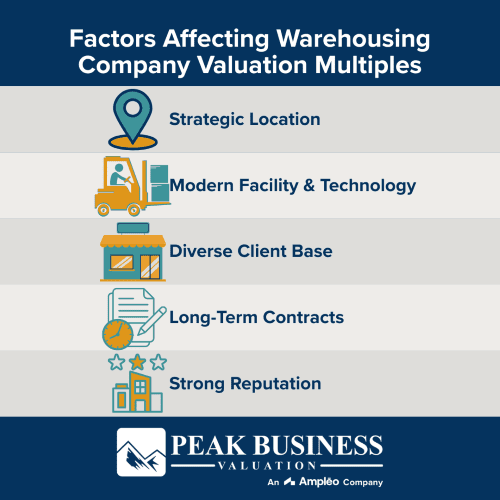
Factors Affecting Warehousing Company Valuation Multiples
There are many variables that determine whether a warehousing company receives higher or lower valuation multiples. Understanding these factors helps warehousing company owners maximize fair market value. Below, we break down several key value drivers for a warehousing company.
- Strategic Location: Warehousing companies located near major transportation hubs, highways, or ports benefit from reduced shipping times and lower transportation costs. This increases operational efficiency and attracts more clients, which can raise the company’s overall value.
- Modern Facility and Technology: Investing in well-maintained facilities with advanced management systems, automated processes, and climate-controlled storage demonstrates efficiency and stability. Moreover, these factors help minimize errors and maintain productivity, supporting strong pricing and favorable warehousing company valuation multiples.
- Diverse Client Base: Maintaining relationships with clients from various industries reduces dependency on a single sector and stabilizes revenue streams. This minimizes financial risk, making the business more attractive to buyers and supporting higher multiples.
- Long-Term Contracts: Securing long-term contracts with clients creates predictable, recurring revenue. Multi-year agreements reduce customer acquisition costs and promote overall stability, which has a major impact on the fair market value of a warehousing company.
- Strong Reputation: Developing a reputation for reliability and efficiency helps warehousing companies differentiate from larger players. A trusted brand reduces customer acquisition risk, supports consistent demand, and increases buyer confidence, often resulting in strong valuation multiples.
Identifying key value drivers is pivotal when preparing to buy or sell a warehousing company. For more information on increasing fair market value, see Value Drivers for a Transportation and Warehousing Company.
Conclusion
Valuation multiples provide a quick estimate of a warehousing company’s potential fair market value. These tools can be useful during initial planning, but should be used with caution. Since valuation multiples overlook unique strengths and weaknesses, they often yield skewed results. As such, relying on warehousing company multiples for important decisions is risky. If you need a credible business valuation for a warehousing company, it is vital to connect with a certified valuation expert.
Peak Business Valuation is a trusted business appraiser that frequently works with warehousing company owners. Whether you are buying or selling a warehousing business, we can provide a timely and reliable warehouse business valuation. Start today by scheduling a free consultation with Peak Business Valuation below!
See How to Value a Transportation and Warehousing Company or Valuation Multiples for a Transportation and Warehousing Company for additional information.