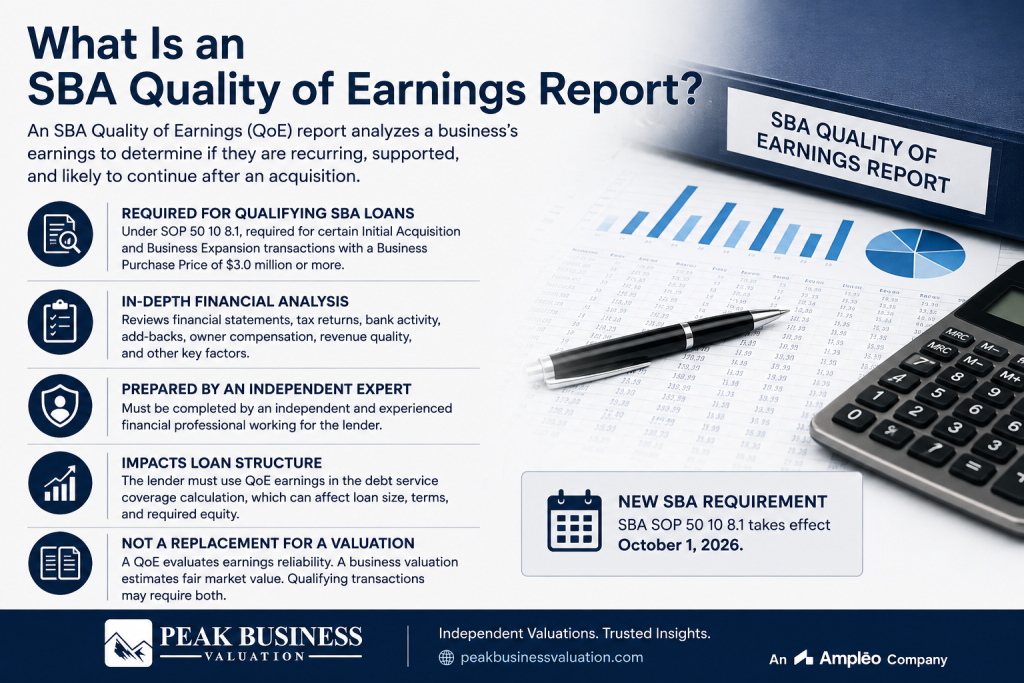
An SBA Quality of Earnings report, often called an SBA QoE, analyzes whether a company’s reported earnings are recurring, supported by the underlying financial records, and likely to continue after an acquisition. For certain SBA-financed acquisitions, a Quality of Earnings analysis is no longer simply an optional layer of buyer due diligence. Under SBA SOP 50 10 8.1, the lender must obtain a separate Quality of Earnings analysis when the applicable Business Purchase Price is $3.0 million or more, subject to the transaction types and exclusions described in the SOP. SBA SOP 50 10 8.1 takes effect on October 1, 2026.
Peak Business Valuation, now part of Ampleo, provides SBA Quality of Earnings analyses through an experienced team of financial professionals with the capacity to support lenders and their borrowers nationwide. Peak has extensive experience working with SBA lenders and understands the requirements of SBA transactions, while Ampleo brings an established Quality of Earnings practice to support the expanded scope of analysis required under SBA SOP 50 10 8.1.
What Does an SBA Quality of Earnings Report Answer?
When Is an SBA Quality of Earnings Report Required?
The requirement applies to qualifying initial acquisition and business expansion transactions when the applicable Business Purchase Price is $3.0 million or more. Certain transaction types, including Owner Buyouts and ESOP or cooperative transactions, are excluded from this specific requirement. The threshold is based on the applicable business purchase price, not solely on the SBA loan amount. Buyer equity, seller financing, and other funding sources do not necessarily reduce the purchase price used to determine whether the requirement applies.
Owner-occupied commercial real estate is generally excluded when applying the threshold. For example, a transaction involving a $2.7 million business and $800,000 of owner-occupied real estate would generally remain below the $3.0 million business purchase-price threshold. A $3.2 million business acquisition would generally exceed the threshold even if the buyer contributes $600,000 of equity.
Lenders should confirm the transaction structure against the current SOP before ordering the work. The SBA 7(a) loan program page provides general program information, while the current SOP controls the specific underwriting requirement.
What Must an SBA Quality of Earnings Report Include?
The SBA-required analysis is broader than a schedule of normalized EBITDA. An SBA QofE report must be prepared for the lender by an independent and experienced financial professional. The preparer must satisfy the independence and experience requirements established by the SBA. The work includes a cash proof covering the trailing twelve-month period and the prior two fiscal years. Bank activity is reconciled to the income statement and tax returns to test whether reported revenue is supported by the business’s actual cash activity.
The analyst also evaluates items that may include:
- Proposed add-backs and other adjustments
- Owner compensation
- Related-party transactions
- Nonrecurring expenses
- Deferred maintenance
- Differences between cash-basis and accrual-basis reporting
- Customer concentration
- Revenue sustainability
- Margin sustainability
- Customer relationships and contract continuity
The article on when an SBA Quality of Earnings report is required explains the transaction types and purchase-price threshold in greater detail.
Lenders should also consider who may prepare an SBA Quality of Earnings report based on the SBA’s independence and experience requirements.
For businesses preparing for the analysis, our Quality of Earnings checklist explains the financial records commonly requested during a Quality of Earnings engagement.
How Does Revenue Quality Affect an SBA QoE?
Revenue is not judged only by its amount. For example, a $5.0 million company with one customer producing 55% of sales may present a different level of risk than a $4.0 million company with recurring contracts and no material customer concentration.
An SBA Quality of Earnings analysis may consider:
- Customer concentration
- Contract continuity
- Recurring versus project-based revenue
- Seasonality
- Pricing changes
- Margin stability
- Whether customer relationships can continue after closing
The purpose is not to predict future performance with certainty. It is to determine whether historical earnings are supported and whether there are identifiable risks affecting their sustainability.
Why Does an SBA Quality of Earnings Report Affect Loan Sizing?
The Quality of Earnings conclusion can directly affect the lender’s underwriting analysis. If the analysis identifies unsupported add-backs, temporary earnings, or other adjustments that reduce supported cash flow, the lender’s repayment analysis may change.
For instance, assume a seller reports $900,000 of EBITDA, including $250,000 of proposed add-backs. If the Quality of Earnings analysis supports only $100,000 of those adjustments, normalized EBITDA falls to $750,000.
The lender can then evaluate debt service coverage using the supported earnings rather than relying solely on the seller’s original presentation. Learn more about how an SBA Quality of Earnings analysis can affect debt service coverage.
A lower earnings conclusion does not automatically mean the business is poor or the transaction cannot close. It means the financing structure must be evaluated based on the earnings supported by the available records.
How Is an SBA Quality of Earnings Report Different From an SBA Business Valuation?
An SBA business valuation estimates the fair market value of the business or ownership interest. A business valuation applies valuation approaches, methods, market evidence, risk assessments, and normalized earnings to reach a value conclusion. Whereas a Quality of Earnings analysis evaluates the reliability and sustainability of the company’s earnings.
The two engagements may review some of the same financial records, but they answer different questions:
- Quality of Earnings: Are the reported earnings supported and sustainable?
- Business Valuation: What is the business worth?
For qualifying SBA transactions, both analyses may be required. The business valuation does not replace the separate Quality of Earnings analysis, and the Quality of Earnings report does not replace the independent valuation. Learn more about the differences between a Quality of Earnings analysis and a business valuation.
What Should Buyers and Lenders Prepare for a QofE?
Preparation should begin before the analyst receives the file. Depending on the transaction and the financial records available, the lender and buyer may need to gather:
- Monthly income statements
- Balance sheets
- Federal tax returns
- IRS transcript data
- Complete bank statements
- General ledgers
- Payroll records
- Debt schedules
- Customer sales reports
- Support for proposed add-backs and adjustments
Early organization matters because the Cash Proof covers multiple periods and unresolved differences can delay the analysis and underwriting process.
SBA Quality of Earnings Services
Peak Business Valuation works with SBA lenders on business valuations, quality of earnings analyses, and machinery and equipment appraisals. For qualifying SBA transactions, an SBA Quality of Earnings report should be considered early in the underwriting process so the required financial records can be identified and the engagement scope can be confirmed. Contact Peak Business Valuation to discuss an SBA Quality of Earnings engagement and the information needed for the analysis.