Do you need to understand the potential value of a food distribution business? Valuation multiples can provide a fair market value estimate to help you make informed business decisions. That said, it is important to understand how to properly use food distributor valuation multiples. With a careful approach, you can avoid costly mistakes and gain useful insights into your company’s worth.
In this article, we break down the most widely used valuation multiples for a food distributor. We also discuss the constraints of relying on these multiples. It is important to note that the ranges provided here are drawn from market data and may not reflect a business’s true worth. If you need a precise food distributor valuation, it is best to connect with a certified business appraiser.
Peak Business Valuation is a professional business appraisal firm. We frequently assist individuals looking to buy, sell, or secure financing for a food distribution business. We are happy to provide you with a certified business valuation! Additionally, we can answer any questions you may have about valuing a food distributor. Get started today by scheduling your free consultation below.
What Are Food Distributor Valuation Multiples?
Valuation multiples are financial ratios used to calculate fair market value based on financial performance metrics (such as earnings or revenue). These figures are determined by assessing comparable food distributors that were recently sold. Once a multiple is selected, it is applied to the distributor’s financial data to get a general value estimate. For more information, see Valuation Multiples for a Food Distribution Business.
Common Food Distributor Valuation Multiples
When valuing a food distributor, Peak Business Valuation primarily focuses on multiples based on SDE, EBITDA, and revenue. Each multiple assesses the business’s value from a different angle. As such, valuation experts often apply a combination of multiples to ensure accuracy. Below is an overview of the most common multiples used to value a food distributor.
SDE Multiples for a Food Distribution Business
Seller’s Discretionary Earnings (SDE) measures the total cash benefit available to a single owner-operator of a food distribution business. To determine SDE, a valuation analyst adjusts net income to include items such as the owner’s salary, bonuses, and discretionary expenses. These multiples are often preferred for smaller food distributors where the owner is heavily involved.
Formula: Value = SDE × Multiple
Range: In the food distribution industry, SDE multiples often fall between 2.37x and 3.38x SDE.
EBITDA Multiples for a Food Distribution Business
EBITDA (Earnings Before Interest, Taxes, Depreciation, and Amortization) reveals a food distributor’s operating profitability. This measurement is more common for larger or multi-unit distribution businesses. It strips out financing and non-cash charges, making it easier to compare other businesses in the industry.
Formula: Value = EBITDA × Multiple
Range: EBITDA multiples for food distributors generally lie between 2.86x and 4.54x EBITDA.
Revenue Multiples for a Food Distribution Business
Revenue multiples compare a company’s value to its total sales over a 12-month period. While these multiples ignore profitability, they can provide useful insight when compared with cash flow multiples like SDE and EBITDA.
Formula: Value = Revenue × Multiple
Range: Food distribution businesses often transact in the range of 0.14x to 0.98x revenue.
As a professional business appraiser, Peak Business Valuation utilizes these multiples during food distributor valuations. In addition, our valuation experts consider unique factors that influence fair market value. Adjusting for these elements helps provide a more tailored conclusion of value. If you have any questions about the valuation process, Peak Business Valuation is happy to help. You can schedule a free consultation below!
How to Value a Food Distribution Business Using Multiples
Applying valuation multiples involves more than plugging numbers into simple formulas. A business appraiser also considers the business’s risk profile, competitive positioning, growth potential, and more. In many cases, a weighted average is applied to help smooth irregular fluctuations and produce a more defensible estimate. Check out How to Value a Food Distributor to learn more.
Rules of Thumb for Food Distribution Businesses
Valuation multiples are convenient rules of thumb for food distribution businesses. Still, these simplified methods cannot account for the nuances of every business. Consequently, relying solely on food distributor valuation multiples may lead to misleading conclusions. If you need a business valuation for buying, selling, or obtaining financing for a food distributor, it is important to receive professional guidance. Peak Business Valuation is here to assist! Reach out to Peak today if you have any questions.
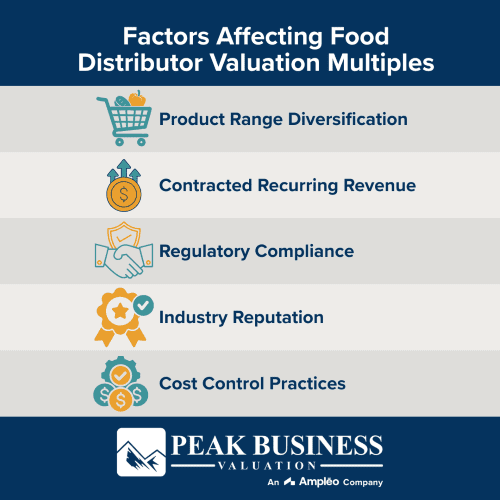
Factors Affecting Food Distributor Valuation Multiples
Several factors influence whether a food distribution business earns higher or lower valuation multiples. Recognizing these elements can help owners strengthen operations and improve. Below are some of the most common value drivers for a food distributor:
- Product Range Diversification: A wide product mix reduces revenue dependency on a single item. This lowers risk and boosts the food distributor’s perceived value, which supports stronger valuation multiples.
- Contracted Recurring Revenue: Long-term supply contracts with supermarkets, food service chains, or institutional clients provide consistent and predictable revenue. This indicates stability and raises the distributor’s overall value.
- Regulatory Compliance: Adhering to health and safety requirements demonstrates reliability and mitigates potential liabilities. This strengthens the company’s position during a valuation.
- Industry Reputation: Food distributors that ensure consistent product quality, reliable delivery, and strong customer service can build a positive reputation. This increases buyer confidence and enhances business value.
- Cost Control Practices: Implementing advanced inventory systems and waste reduction strategies help lower running costs and increase margins. Strong cost efficiency supports healthy cash flow, which positively impacts food distributor valuation multiples.
Focusing on the above value drivers can help maximize the value of a food distribution business. Read Value Drivers for a Food Distributor for additional guidance.
Conclusion
Food distributor valuation multiples offer a simple method to estimate the value of a food distributor. However, these tools often overlook key elements that affect a business’s overall worth. If you need a defensible food distributor valuation, it is vital to work with a certified business appraiser. These professionals follow standardized valuation processes to ensure a precise fair market value estimate
Peak Business Valuation, business appraiser, regularly works with food distribution businesses throughout the United States. Whether you are buying, growing, or selling a food distributor, we can support you with a quick and accurate business valuation. We are also available to answer any questions about using food distributor valuation multiples. Start by scheduling your free consultation today.
See Valuation Multiples for a Food Distribution Business or How to Value a Food Distributor for more information.