
Dry Cleaning Valuation Multiples
The dry cleaning business model has proven to be a profitable venture for thousands of entrepreneurs. With the right strategy, buying, expanding, or selling a dry cleaning business can be very rewarding. However, it is important to understand the business’s fair market value before making any critical decisions. This information is extremely useful during negotiations, planning, and deal structuring. For a quick fair market value estimate, dry cleaning valuation multiples are a common starting point. That said, there are a few vital implications to be aware of when using these tools to value a dry cleaning business.
In this article, we discuss the most common valuation multiples for a dry cleaning business. Additionally, we highlight key risks to consider when applying them. Keep in mind that the benchmark ranges we provide represent industry averages and may not reflect your business’s precise value. If you need a defensible business valuation, it is important to consult a certified valuation expert.
As a trusted business appraiser, Peak Business Valuation works with dry cleaning businesses across the United States. Whether you are seeking financing, preparing for a sale, or identifying growth opportunities, we can provide a fast and accurate dry cleaning business valuation. If you have questions about valuing a dry cleaning business, schedule your free consultation below!
What are Dry Cleaning Valuation Multiples?
Valuation multiples are financial ratios used to estimate a company’s value based on market trends. Business appraisers determine appropriate multiples by examining recent sales of similar dry cleaning businesses. These multiples are then applied to specific financial metrics, like earnings or revenue, to estimate fair market value. For additional information, check out Valuation Multiples for Dry Cleaning.
Common Dry Cleaning Valuation Multiples
When valuing a dry cleaning business, valuation experts at Peak Business Valuation often rely on SDE, EBITDA, and revenue-based multiples. Each metric assesses a different aspect of the business to estimate fair market value. To ensure an accurate valuation, business appraisers commonly apply more than one valuation multiple. Below, we describe SDE, EBITDA, and revenue multiples and provide a typical range for each in this industry.
SDE Multiples for a Dry Cleaning Business
Seller’s Discretionary Earnings (SDE) represents the total financial benefit a single owner-operator can expect from the business. Using an SDE-based multiple is a common valuation method for small- to mid-sized dry cleaning companies. To calculate SDE, the valuation analyst adds the owner’s salary, discretionary expenses, and one-time costs back to net income. See the valuation formula and benchmark range below:
Formula: Value = SDE × Multiple
Range: For dry cleaning businesses, SDE multiples typically range from 1.95x to 2.93x SDE.
EBITDA Multiples for a Dry Cleaning Business
Earnings Before Interest, Taxes, Depreciation, and Amortization (EBITDA) measures operating profitability without the impact of non-operational expenses. EBITDA multiples are most often applied to larger dry cleaning companies or those with multiple locations. This method also allows for more accurate comparisons between similar dry cleaning businesses.
Formula: Value = EBITDA × Multiple
Range: EBITDA multiples for dry cleaning businesses generally fall between 2.49x and 4.14x EBITDA.
Revenue Multiples for a Dry Cleaning Business
Revenue represents a dry cleaner’s gross sales over a 12-month period. While these multiples do not consider operating expenses or profitability, they can serve as a useful reference alongside SDE or EBITDA multiples.
Formula: Value = Revenue × Multiple
Range: Dry cleaning businesses often transact within a revenue multiple range of 0.47x to 0.89x.
Peak Business Valuation, business appraiser, has extensive experience with dry cleaning valuation multiples. As part of a comprehensive valuation, our business appraisers also account for the business’s risk profile, growth potential, market position, and more. This process provides reliable results to help you make informed decisions. If you have any questions about how to value a dry cleaning business, we are happy to help! Schedule your free consultation with Peak Business Valuation by clicking below.
How to Value a Dry Cleaning Business Using Multiples
For accurate results, applying dry cleaning valuation multiples involves more than just applying the above formulas. A comprehensive dry cleaning business valuation requires adjustments for the company’s unique strengths, weaknesses, and market conditions. Moreover, Peak Business Valuation often normalizes results to account for seasonal fluctuations or unusual expenses. Read How to Value a Dry Cleaning Business for more guidance.
Rules of Thumb for Dry Cleaning Businesses
Valuation multiples are often referred to as “rules of thumb” because they provide a quick, general fair market value estimate. It is important to understand that rules of thumb can overlook important factors that affect the value of a specific dry cleaning business. While these rules can be useful for initial planning, they should never guide major business decisions. This can lead to costly mistakes. The best way to ensure a reliable dry cleaning business valuation is to work with a professional business appraiser. Reach out to Peak Business Valuation today if you have any questions!
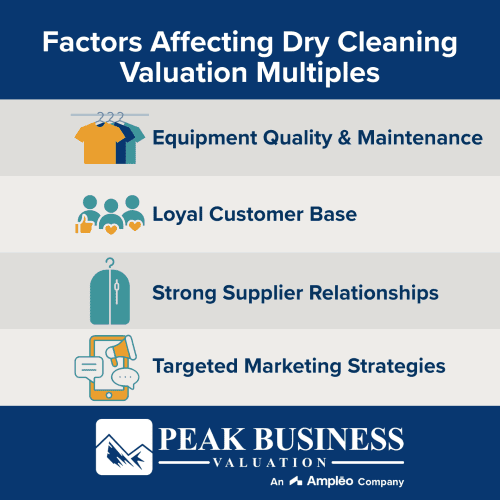
Factors Affecting Dry Cleaning Valuation Multiples
Many variables can determine whether a dry cleaning business trades at higher or lower multiples. Understanding these factors can help owners identify areas of improvement and maximize their dry cleaner’s value. Common value drivers for a dry cleaning business include:
- Equipment Quality & Maintenance: Utilizing energy-efficient machines reduces utility costs, improves turnaround times, and enhances overall service quality. These factors help lower the dry cleaning business’s risk profile, leading to higher valuation multiples.
- Loyal Customer Base: Developing and maintaining a loyal customer base promotes steady, predictable cash flow. This is an appealing factor to those looking to buy or invest in a dry cleaning company.
- Strong Supplier Relationships: Establishing long-term partnerships with suppliers ensures reliable access to essential cleaning materials at favorable prices. This enables competitive pricing and can boost the dry cleaner’s perceived worth.
- Targeted Marketing Strategies: Implementing aggressive marketing techniques helps attract new customers and retain existing ones. As such, running promotions, targeted advertising, and loyalty programs can improve your dry cleaner’s market position and overall value.
See Value Drivers for a Dry Cleaning Business to learn more.
Conclusion
If you want a general understanding of a dry cleaning business’s value, valuation multiples are helpful tools. However, dry cleaning valuation multiples are simplified methods that often lack accuracy. When preparing to buy, grow, or sell a dry cleaning business, it is best to receive a professional business valuation. During the valuation process, a certified expert considers the unique factors that influence a dry cleaning business’s worth. This provides reliable insights, enabling informed decision-making.
Peak Business Valuation is a professional business appraiser. We regularly value dry cleaning businesses throughout the nation. We are here to answer your questions about dry cleaning valuation multiples or how to value a dry cleaning business. Get started today by scheduling a free consultation with Peak Business Valuation below!
For more information, read Dry Cleaning Business Valuation or Valuing a Dry Cleaning Business.