
Hotel Valuation Multiples
Valuation multiples are a great starting point if you are looking to understand the potential fair market value of a hotel. These figures provide a broad value estimate based on certain financial performance indicators and general market trends. This makes hotel valuation multiples a common guideline for preliminary planning. However, there are a few important implications to understand if you are navigating critical business decisions.
In this article, we discuss the most common hotel valuation multiples and how they are applied. Additionally, we highlight the risks of relying solely on multiples for decision-making. Please keep in mind that the ranges we provide below reflect industry averages and will not reflect the precise value of a hotel. For the most accurate hotel valuation, it is best to consult a certified business appraiser.
Peak Business Valuation is a professional business appraisal firm that works with hotels throughout the nation. We can provide you with a quick and reliable business valuation for a hotel! In addition, we can address any questions on how to value a hotel business. Start today by scheduling a free consultation with Peak Business Valuation below.
What are Hotel Valuation Multiples?
Hotel valuation multiples are financial ratios used to estimate fair market value based on income and cash flow metrics. These ratios are determined by analyzing sales of comparable hotels that recently sold. Once an applicable multiple is identified, it can be applied to your hotel’s financial data to calculate its fair market value. To learn more about this valuation method, see Valuation Multiples for a Hotel or Motel.
Common Hotel Valuation Multiples
When determining how to value a hotel, business appraisers often gather multiples based on SDE, EBITDA, and revenue. Each multiple calculates the value of a hotel from a different angle. In many cases, a combination of these metrics is used to provide a more balanced valuation. Below, we break down the most popular valuation multiples for hotels and their typical industry ranges.
SDE Multiples for a Hotel Business
Seller’s Discretionary Earnings (SDE) indicate the total financial benefit available to a single owner-operator of a hotel. To calculate SDE, valuation experts add back items such as owner’s compensation, discretionary expenses, and nonrecurring costs to net income. A multiple can then be applied to this figure provide an estimate of fair market value. SDE multiples are most often used for smaller hotel businesses.
Formula: Value = SDE × Multiple
Range: Hotel SDE multiples generally range from 1.14x to 2.54x SDE.
EBITDA Multiples for a Hotel Business
Earnings Before Interest, Taxes, Depreciation, and Amortization (EBITDA) measure a hotel’s profitability before non-operational expenses. EBITDA multiples are especially useful when evaluating and comparing larger hotel companies.
Formula: Value = EBITDA × Multiple
Range: Hotel EBITDA multiples often fall between 1.57x and 3.34x EBITDA.
Revenue Multiples for a Hotel Business
Revenue represents the total sales a hotel generates over a given 12-month period. Please note that revenue-based multiples are often less reliable since they do not account for profitability. However, they can provide helpful insight when considered alongside earnings-based multiples like SDE or EBITDA.
Formula: Value = Revenue × Multiple
Range: Hotel revenue multiples typically range from 0.40x to 0.98x revenue.
As a professional business appraiser, Peak Business Valuation applies a variety of hotel valuation multiples during a business appraisal. We also analyze the hotel’s risks, market conditions, and unique strengths to tailor the hotel valuation. If you need a reliable independent business valuation, we are here to assist! Schedule your free consultation with Peak Business Valuation by clicking the button below.
How to Value a Hotel Business Using Multiples
Properly applying hotel valuation multiples involves more than plugging numbers into simple formulas. Business appraisers also account for unique factors that impact value such as occupancy rates and demand fluctuations. Moreover, Peak Business Valuation often uses weighted averages to account for irregularities or nonrecurring financial items. This process ensures a more comprehensive and precise hotel valuation. To learn more about the valuation process, see How to Value a Hotel or Motel.
Rules of Thumb for Hotels
Valuation multiples are popular rule-of-thumb methods for valuing a hotel. However, these methods are highly generalized and do not capture the unique characteristics of each hotel business. As such, relying on these figures for important financial decisions can be risky. If you need a defensible hotel valuation for buying, selling, or securing financing for a hotel, it is crucial to work with a certified appraiser. Reach out to Peak Business Valuation today if you have any questions.
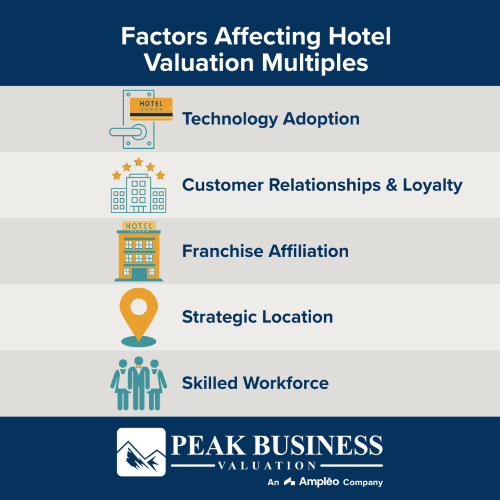
Factors Affecting Hotel Valuation Multiples
Many factors influence whether a hotel receives higher or lower valuation multiples. Understanding these elements can help business owners maximize the fair market value of their hotel. Below we discuss some common value drivers for hotels:
- Technology Adoption: Hotels can boost operational efficiency by implementing new technology such as booking systems and management platforms. This can give the business a competitive advantage and raise valuation multiples.
- Customer Relationships and Loyalty: Building strong guest relationships encourages repeat visits and fosters a positive reputation. This helps drive demand and supports strong hotel valuation multiples.
- Franchise Affiliation: Being part of a franchise or hotel chain provides access to national marketing, quality control, and brand recognition. These factors can boost investor confidence and the hotel’s perceived value.
- Strategic Location: Hotels positioned near major cities, airports, and tourist attractions often see higher occupancy rates, translating to stronger financial performance and higher multiples.
- Skilled Workforce: Securing a well-trained staff enhances service quality and helps differentiate a hotel from alternative lodging options. This helps improve profitability and the overall value of the business.
To learn more about growing the value of a hotel, see Value Drivers for a Hotel or Motel.
Conclusion
Hotel valuation multiples can offer helpful insight for early planning. However, hotel valuation multiples are based on market averages and do not account for the unique qualities of every business. As such, these tools should never be used in place of a professional business appraisal. If you need reliable data to guide important decisions, it is crucial to work with a valuation expert. These certified professionals use standardized techniques to ensure a precise hotel valuation.
Peak Business Valuation, professional business appraiser, works with hotels across the United States. We are here to provide you with a hotel valuation and answer any questions you may have on how to value a hotel business. You can start today by scheduling your free consultation below!
To learn more, read Hotel Valuations or Valuing a Hotel or Motel.