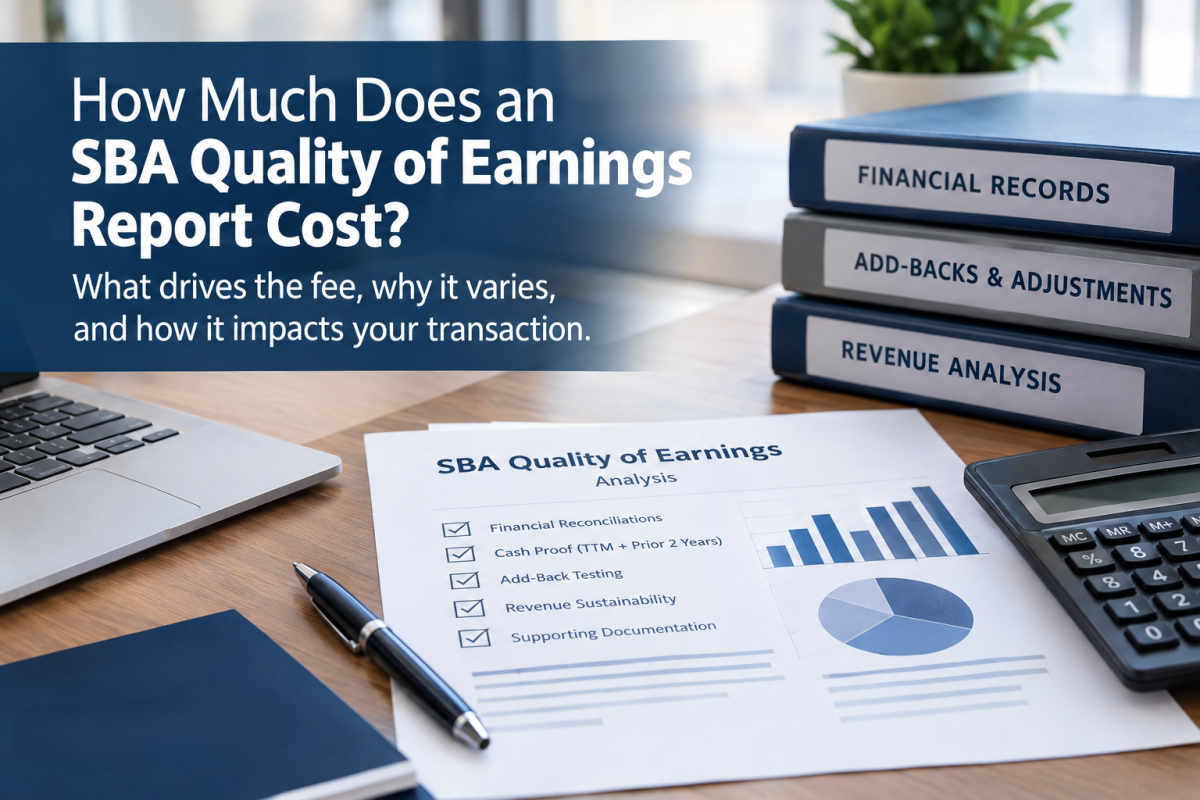
There is no universal SBA fee for a Quality of Earnings report. SBA Quality of Earnings cost is a professional-services fee based on the provider and the scope of the engagement. The number of entities, bank and merchant accounts, reporting systems, periods, adjustments, revenue streams, and unresolved accounting issues can matter more than company revenue or purchase price.
At Peak Business Valuation, we provide lender-directed SBA Quality of Earnings services nationwide. We price each engagement based on the transaction and work required rather than using a one-size-fits-all fee. If you are an SBA lender or transaction advisor, contact Peak Business Valuation early so we can help define the scope and provide a clear quote.
What Drives SBA Quality of Earnings Cost?
Professional hours and complexity are usually the biggest cost drivers for an SBA QoE. Company revenue can matter, but it doesn’t fully reflect the work involved. For example, a $4 million revenue company with one entity, two bank accounts, clean monthly financials, and ten documented adjustments may be easier to review than a $2 million company with four entities, twelve accounts, incomplete books, and hundreds of proposed owner expenses.
Common scope drivers include:
- Number of legal entities and locations
- Number of bank, merchant, and deposit accounts
- Cash-basis versus accrual-basis accounting
- Quality of monthly financial statements
- Condition of the general ledger
- Number and size of proposed add-backs
- Related-party transactions and owner compensation
- Customer concentration and contract analysis
- Inventory or revenue-recognition issues
- Amount of follow-up needed to reconcile source records
Why Does the Cash Proof Affect the Fee?
A Cash Proof adds transaction-level work to an SBA QoE. The analyst must identify relevant accounts, summarize deposits, remove transfers and other non-revenue items, and explain timing or accounting differences. A company with two operating accounts and no merchant processor will generally require less Cash Proof work than a multi-location business using several processors and bank accounts.
For applicable transactions, SOP 50 10 8.1 includes Cash Proof testing for the trailing twelve months and prior two fiscal years. SBA lender resources identify SOP 50 10 8.1 as effective October 1, 2026. Peak’s SBA Cash Proof guide provides more detail on how deposits are reconciled to reported revenue and why multiple accounts or processors can increase the work involved.
How Do Add-Backs Affect the SBA QoE Fee?
A short, well-supported add-back schedule is different from a broad recast that groups personal and nonrecurring expenses without transaction detail. Assume a seller proposes five adjustments totaling $200,000 and provides general-ledger entries, invoices, payroll support, and explanations. That may be relatively efficient to test. Now compare that with $500,000 of proposed adjustments across vehicle expenses, travel, family payroll, legal fees, owner benefits, and related-party expenses with little supporting documentation. The second assignment requires more tracing, management questions, and professional judgment.
Peak Business Valuation’s SBA add-back verification article explains why proposed adjustments must be supported rather than accepted simply because they appear on a seller’s schedule. For additional questions, schedule a free consultation today!
Does the SBA Set a Standard QoE Fee?
No. The SBA does not establish a universal professional fee for a Quality of Earnings engagement. The SBA sets requirements for the work on covered transactions, but providers determine their fees. Lenders should therefore compare proposals based on scope as well as price. Two proposals may have different fees because one includes more reconciliation, Cash Proof testing, add-back analysis, or revenue testing.
Can Two Companies With the Same Purchase Price Have Different Fees?
Yes. Purchase price can determine whether a transaction falls within the SBA’s mandatory QoE requirements, but it does not determine the amount of work required. Consider two hypothetical $3.5 million acquisitions.
Company A has one entity, one accounting system, three bank accounts, complete monthly records, and modest add-backs.
Company B has three operating entities, two related real estate entities, nine bank and merchant accounts, inconsistent cash-basis records, and several material related-party transactions.
The second engagement would normally require more reconciliation and analysis even though the purchase prices are identical. Therefore, the SBA quality of earnings cost would be different.
What Information Is Needed for a Reliable QoE Quote?
A provider can usually scope an engagement more accurately when the lender provides:
- Purchase agreement or transaction summary
- Business Purchase Price
- Entity structure
- Expected closing date
- Lender-specific requirements
- Recent financial statements
- Number of bank and merchant accounts
- Accounting method
- Add-back schedule
- Known record limitations
A quote based only on annual revenue can change when fieldwork reveals additional entities, missing accounts, or significant source-record issues. Providing a complete data package early can also reduce avoidable work. For more information, see Peak Business Valuation’s SBA Quality of Earnings Documents for a useful checklist of records commonly needed for a QoE. Or schedule a free consultation using the link below.
Does a Higher QoE Fee Mean a Better Report?
Not necessarily. Price should not be the only factor, but a higher fee does not automatically mean a better engagement either. The lender should confirm that the provider has appropriate experience and that the proposed scope addresses the required procedures. The proposal should clearly state what is included and identify its assumptions. The provider’s compensation should also be independent of the QoE conclusion. The fee should not depend on reaching a target earnings number, purchase price, loan amount, or successful closing.
At Peak Business Valuation, we believe lenders should be able to understand exactly what they are paying for and the SBA quality of earnings cost. Our SBA QoE proposals are based on the transaction’s scope and complexity, including the number of entities, accounts, periods, add-backs, and other procedures required. That gives the lender a clearer expectation of both SBA quality of earnings fee and deliverables before the work begins.
How Does SBA Quality of Earnings Cost Relate to Underwriting?
The professional fee is small compared with the potential economic impact of the analysis. If supported earnings are lower than the seller’s adjusted earnings, the difference can affect debt service coverage, SBA loan sizing, buyer equity, seller financing, or the purchase price. If the QoE supports higher recurring earnings, the lender must still consider the valuation, transaction structure, SBA requirements, and other underwriting factors. The purpose of the QoE is to determine supported and sustainable earnings—not to justify a particular loan amount or save a transaction.
How Can You Control Avoidable QoE Costs?
The best way to control avoidable costs is to provide complete information at the beginning. Identify all entities and accounts. Provide complete bank statements and monthly financials. Reconcile financial statements to the general ledger. Support proposed add-backs at the transaction level. Identify known accounting limitations before fieldwork begins. The lender should also define the expected Quality of Earnings scope early. This gives the provider a better basis for a fixed or clearly defined fee and reduces the risk of scope changes later.
Conclusion: What Should You Expect to Pay for an SBA QoE?
There is no standard SBA QoE fee. SBA Quality of Earnings cost depends primarily on the scope, complexity, quality of the records, and amount of professional analysis required. Revenue and purchase price provide context, but they are not enough to determine the fee. Entity structure, bank accounts, Cash Proof requirements, add-backs, revenue complexity, and unresolved accounting issues can have a much greater impact on the work.
At Peak Business Valuation, we provide independent, lender-directed SBA Quality of Earnings analyses for SBA transactions nationwide. We can review the transaction structure and available records, help define the scope, and provide pricing before the engagement begins. If you are an SBA lender, buyer, seller, or transaction advisor planning a covered transaction, contact Peak Business Valuation to discuss the expected scope, pricing, and timing.