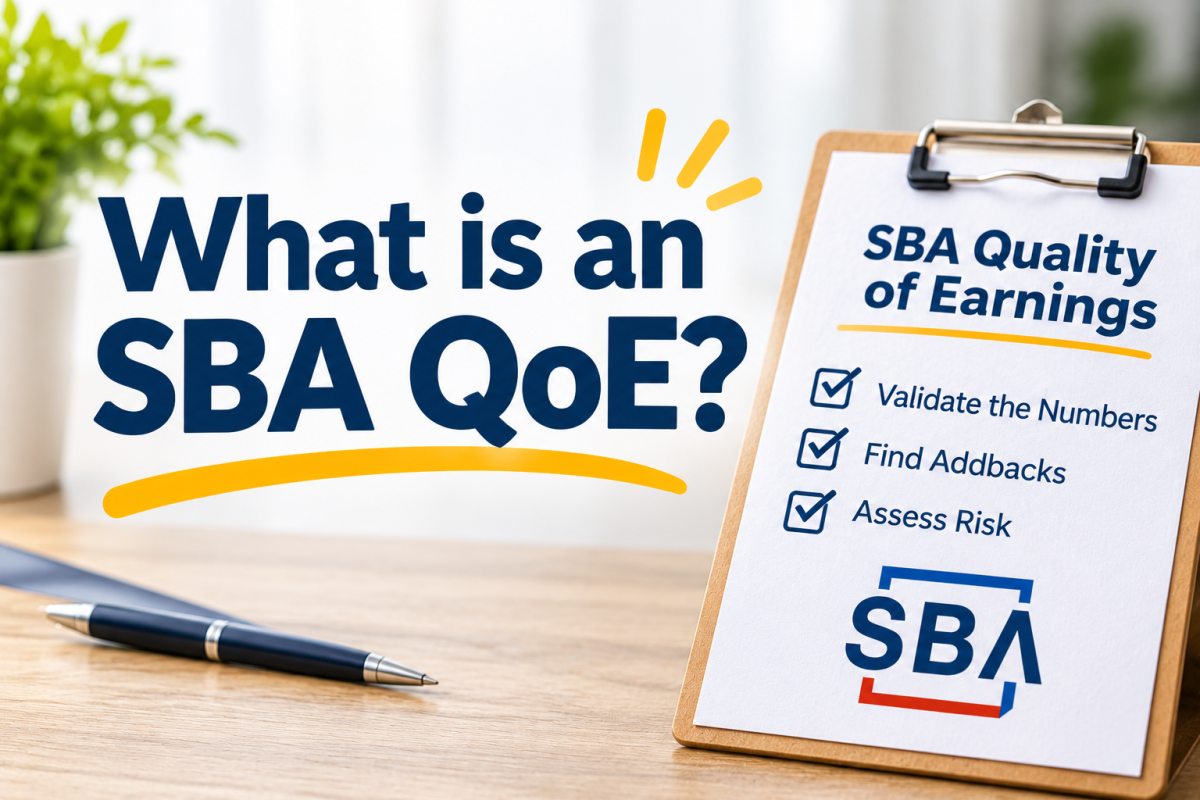
An SBA QoE, short for SBA quality of earnings, is an independent review of the earnings a business reports. The analyst checks financial records to see how much cash the business brings in and to verify that earnings come from its day-to-day work. They also check the seller’s add-backs. These are costs the seller wants to take out of the earnings calculation, such as a one-time expense. This review helps SBA lenders judge whether the business can earn enough to cover the proposed loan payments.
For example, suppose a seller reports $1.1 million in adjusted EBITDA. That figure includes $300,000 in proposed add-backs. The analyst checks the records and finds support for just $120,000 of those add-backs. Removing the other $180,000 brings normalized EBITDA down to $920,000. The SBA lender uses that figure to calculate debt service coverage.
At Peak Business Valuation, we work with SBA lenders and buyers across the country. We frequently provide business valuations and Quality of Earnings reviews. As such, we can walk you through what an SBA QoE covers and help you determine if your deal needs one. Schedule a free consultation below.
When Does the SBA Require a QoE?
The SBA requires a quality of earnings for certain 7(a) deals when the business purchase price is $3 million or more. The rule took effect on October 1, 2026, under Appendix 15 of SOP 50 10 8.1. As such, the SBA lender must compare the business purchase price with the $3 million threshold. This step comes before the lender factors in buyer equity, seller financing, or other funds.
If the sale includes owner-occupied commercial real estate, the lender subtracts its appraised value from the total price. For example, a $3.5 million deal with $900,000 in appraised real estate has a business purchase price of $2.6 million. That puts the deal below the $3 million threshold.
Covered Deals
There are two types of 7(a) deals that can require an SBA quality of earnings once the business purchase price reaches $3 million:
- Initial Acquisition: A new owner usually buys more than half the business or takes the largest stake.
- Business Expansion: An existing business buys another company in the same industry group.
Once the lender identifies the deal type, the next step is to check whether an exemption applies.
Exempt Deals
Some deals stay exempt even at $3 million or more. These deals include:
- Owner Buyouts: Existing owners can buy out other owners without a QoE if the deal meets the SBA’s owner buyout rules.
- Employee Stock Ownership Plans (ESOPs) and Cooperatives: An ESOP or cooperative can qualify for the exemption when it buys a controlling stake in the business.
- Owner-Occupied Special-Purpose Property: This exemption applies at any price if the business needs the property to keep running.
If you are unsure whether your deal needs an SBA QoE, Peak Business Valuation can help. We can walk through the price and terms of the deal and explain what records to gather if you need a report.
What Does an SBA QoE Include?
An SBA QoE examines the records behind reported earnings to determine how much the business can continue to earn. The report covers four core components:
- Financial Reconciliation: The analyst compares financial statements, tax returns, internal records, and IRS transcripts to identify differences. They use these findings to calculate normalized earnings, which reflect income from the normal course of business.
- Add-Back Testing: The analyst checks the records behind each proposed add-back and other earnings adjustments. This includes one-time expenses, owner pay, transactions with related parties, deferred maintenance, and differences between cash and accrual accounting.
- Revenue Quality: The analyst reviews how much revenue comes from key customers and whether contracts will continue after the sale. These findings help assess whether the business can maintain its sales and profit margins.
- Cash Proof: The analyst compares bank activity with the income statement and tax returns to check whether cash received and spent supports the reported figures. This covers the trailing twelve months and two prior fiscal years, or the available operating history for a business less than two years old.
The SBA lender uses the earnings supported by the QoE to calculate debt service coverage, which measures the ability to cover loan payments. Initial Acquisitions generally require coverage of at least 1.25 times annual debt payments, while Business Expansions require at least 1.15 times. The lender bases this calculation on historical earnings. If those earnings cannot support the proposed debt, the loan amount must decrease.
How to Prepare for an SBA Quality of Earnings
Preparing for an SBA QoE starts with gathering financial records and confirming the lender’s requirements. These steps help the quality of earnings analyst review the business and help buyers understand the timing, scope, and cost before the review begins.
Gather Key Business Records
Start by gathering bank statements, year-end financial statements, and tax returns. In addition, include accounts receivable and payable aging reports. These records show how long customer invoices and unpaid bills have been outstanding. The analyst uses the documentation to compare reported earnings with cash received and amounts still owed.
Organizing these documents early can reduce delays caused by missing records. Peak’s Quality of Earnings checklist provides more detail on what buyers and sellers should prepare.
Ask the SBA Lender Clarifying Questions
Once you know which records to gather, confirm how the lender wants to handle the review. The following questions can help you prepare:
- Can a Buyer’s QoE Count? If you already have a QoE, ask whether the lender can use it and what additional review or reliance documentation it requires. Confirm these requirements before ordering another report.
- When Should the Engagement Start? For loans under the Preferred Lenders Program (PLP), the SBA lender must have retained the provider and have an engagement letter in place when the SBA issues the loan number. Ask the lender when it needs the completed report.
- What Does It Cost? Fees depend on the scope of the review and the business’s financial records. Ask for a quote and confirm who will pay so you can account for the cost before the review begins.
- Who Can Prepare the Report? The SBA requires an independent, experienced financial professional to prepare the report for the lender’s benefit. Ask the lender which providers it approves and what experience it expects them to have.
Conclusion
An SBA QoE is a financial analysis that helps lenders determine whether a business’s earnings can support the proposed loan payments. It is required for qualifying 7(a) Initial Acquisitions and Business Expansions with a business purchase price of $3 million or more. Understanding the requirements and gathering records early can help buyers prepare for the review.
Peak Business Valuation works with lenders and buyers on SBA Quality of Earnings reviews and business valuations nationwide. Our team can explain what the review covers, help you prepare the needed records, and address questions about your transaction. Schedule a free consultation with Peak Business Valuation to discuss your next steps.