
Hair Salon Valuation Multiples
Determining the value of a hair salon is an important step whether you are planning to buy, sell, or grow your business. One of the most common methods for estimating fair market value is applying hair salon valuation multiples. These tools provide a quick calculation based on recent hair salon transactions. While multiples offer useful insights, there are a few important implications to keep in mind when using them.
In this article, we outline common valuation multiples for a hair salon. We also explain how multiples are applied and the risks of relying on this method. Please note that the ranges provided in this article reflect market averages and will not provide a precise hair salon valuation. If you need to understand the true value of your hair salon, it is best to consult a certified valuation expert.
As a professional business appraiser, Peak Business Valuation frequently works with individuals who are buying, growing, or selling a hair salon. We are happy to provide you with a quick and reliable hair salon valuation. In addition, we can address any questions on how to value a hair salon or using valuation multiples. You can begin today by scheduling a free consultation with Peak Business Valuation below!
What are Hair Salon Valuation Multiples?
Hair salon valuation multiples are financial ratios that measure the value of a salon using financial metrics such as earnings or revenue. These multiples are derived by analyzing recent sales of comparable hair salons in the marketplace. After identifying the appropriate multiples, they can be applied to your company’s financial data to estimate its fair market value. For more details on using multiples, see Valuation Multiples for a Hair Salon.
Common Hair Salon Valuation Multiples
When determining how to value a hair salon, business appraisers often assess SDE, EBITDA, and revenue multiples. Each multiple measures a different aspect of the salon’s worth. To provide a more accurate valuation, business appraisers often use a combination of valuation multiples. Below, we discuss the most common valuation multiples for hair salons and provide typical ranges for this industry.
SDE Multiples for a Hair Salon
Seller’s Discretionary Earnings (SDE) represent the total financial benefit available to a single owner of a hair salon. This metric is most applicable to smaller, owner-operated salons. To calculate SDE, valuation experts add back items such as the owner’s compensation, discretionary expenses, and any one-time costs to net income.
Formula: Value = SDE × Multiple
Range: Hair salon SDE multiples typically range from 1.15x to 2.28x SDE.
EBITDA Multiples for a Hair Salon
Earnings Before Interest, Taxes, Depreciation, and Amortization (EBITDA) measure a salon’s operating profitability before non-operational expenses. EBITDA multiples are particularly useful when assessing and comparing larger hair salons.
Formula: Value = EBITDA × Multiple
Range: Hair salon EBITDA multiples commonly fall between 2.0x and 4.0x EBITDA.
Revenue Multiples for a Hair Salon
Revenue refers to a salon’s total sales over a 12-month period. Since revenue multiples do not account for profitability, they are typically considered less reliable. However, these multiples can be a helpful reference when analyzed alongside SDE and EBITDA multiples.
Formula: Value = Revenue × Multiple
Range: Hair salons often trade within a revenue multiple range of 0.25x to 0.60x.
Peak Business Valuation, trusted business appraiser, uses hair salon valuation multiples when performing a professional business valuation. In addition, we evaluate the company’s risks, competitive advantages, and market conditions to adjust the final conclusion of value. This thorough process results in a precise, defensible hair salon valuation. If you need an independent business valuation for a hair salon, we are here to help! Schedule your free consultation with Peak Business Valuation by clicking the link below.
How to Value a Hair Salon Using Multiples
To effectively use hair salon valuation multiples, there are many important factors to consider. As part of the valuation process, experts assess unique variables such as booking rates, service mix, and lease quality. Moreover, weighted averages may be applied to account for unusual or non-recurring items. This ensures the valuation reflects the hair salon’s true performance. To learn more about the valuation process, see How to Value a Hair and Nail Salon.
Rules of Thumb for Hair Salons
Valuation multiples are popular rules of thumb for estimating the value of a hair salon. However, these simplified methods often overlook critical aspects of a salon’s value. As such, valuation multiples should be used with caution, especially when making major financial decisions. If you need a defensible hair salon valuation, it is important to connect with a certified business appraiser.
Factors Affecting Hair Salon Valuation Multiples
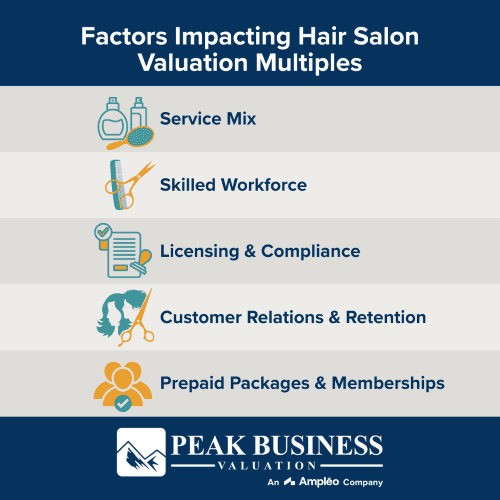
Several key factors influence whether a hair salon receives higher or lower valuation multiples. Understanding these variables can help you strengthen the hair salon’s performance and increase its fair market value. Below, we highlight several key value drivers for a hair salon:
- Service Mix: Offering a broad mix of services such as balayage, keratin treatments, and extensions, can help diversify revenue streams. This boosts a hair salon’s financial stability, promoting higher valuation multiples.
- Skilled Workforce: Hiring and training skilled hair technicians ensures consistent, high-quality service. This attracts clients and stabilizes cash flow, which has a major impact on a salon’s overall value.
- Licensing & Compliance: Acquiring proper licensing ensures regulatory compliance. This mitigates operational risk, protects clients, and enhances the hair salon’s reputation. These factors make the business more attractive to buyers and investors.
- Customer Relations & Retention: Building strong client relationships encourages repeat business and customer loyalty. This reduces revenue volatility and supports higher valuation multiples.
- Prepaid Packages and Membership Programs: Offering prepay options and membership programs helps secure predictable future revenue. This gives buyers and investors confidence in your hair salon, raising its perceived value.
To learn more about raising your hair salon’s value, see Value Drivers for a Hair Salon.
Conclusion
If you want an understanding of a hair salon’s potential value, valuation multiples are a good starting point. However, hair salon valuation multiples are based on generalized data and do not account for the specific strengths and weaknesses of each salon. As such, these tools can be misleading. If you need a defensible hair salon valuation, it is best to work with a certified independent business appraiser. These experts take thorough measures to account for unique variables that affect your hair salon’s value.
Peak Business Valuation is a professional business appraisal firm that works with hair salons throughout the country. We are happy to support you with a reliable business valuation. Additionally, we can discuss any questions you may have about valuing a hair salon or using hair salon valuation multiples. Get started today by scheduling your free consultation below!
To learn more, check out Hair Salon Valuations or Valuing a Hair Salon.